


Stress may wear you out both mentally and bodily. But before you worry about worrying, know that a straightforward mindfulness practice has been proven to effectively reduce stress.
You won't need to pay for an hour of classes or force your body into uncomfortable positions, so don't worry. Probably you already have all the resources needed to engage in the Mindful Techniques For Stress.
Simple creative mindfulness techniques for Stress Management
1. Make a resolution
Your yoga instructor asks you to establish a goal for what you do that day for a reason. Establishing an intention may assist you focus and keep you reminded of why you are doing something, whether you do it in your morning notebook or before significant events. Set a goal for it if anything makes you nervous, like giving a major speech at work.
Before going to the gym or before eating, you may, for instance, make a conscious effort to take care of your body.
2. Practice awareness or a guided meditation (thought Patterns Therapy)
Finding a little area and launching an app can be all it takes to practice meditation. Apps and online courses are excellent ways to try out a profession without enrolling in a costly class or devoting a lot of time. Online, there are innumerable guided meditations that are free. A nice place to start is with this selection of online meditation choices.
3. Sketch or color.
Give yourself a few minutes to draw. You'll unleash your creativity and give your mind a rest. Do you find drawing stressful? Buy a coloring book—adult or not—without any shame. You'll enjoy the benefit of feeling accomplished rather than staring at a blank page. It helps to you overcome the problem of mindful techniques for stress.
4. Send positive vibes to others.
Make sporadic wishes for someone to be joyful throughout the day. This training is entirely mental. You only need to set the positive vibe; you don't even need to notify the person. Try it while you're waiting in line, in your cubicle, at the fitness center, or on your commute. Bonus points if, when being irritated or angry with someone, you pause and (mentally) offer them joy. Meng may be on to anything with his eight applications for the Nobel Peace Prize.
5. Search
Look up at the stars instead of simply the television in front of you (but you should do that too). Whether you're emptying the garbage or arriving home late, pause, take a few belly breaths, and gaze up at the sky. Let the universe serve as a reminder that life is bigger than your concerns or email.
6. Take a sip
Many cultures all around the world hold making a cup of tea in high regard. Concentrate on each step as you settle into the practice. When you remove the leaves, how do they smell? What color does the water have when the tea is initially added? Feel the warmth of the cup on your hand while seeing the steam rise from it. Enjoy your tea without interruption if you have the time.
Mindful Techniques For Stress
Because of its critical role in lowering stress and enhancing general health, mindfulness, or the awareness that arises by paying attention moment by moment without judgment, is becoming more and more popular in many circles.
But in order to get the full rewards of mindfulness, mindful reflection practices are required, just like with any other habit.
1. Floating or Swimming on Water
Swimming works every muscle in the body without straining the joints.
A great deal of physical stress can be relieved by introducing movement into tight and tense places. This improves mobility and permits more oxygen to reach muscles that aren't used as frequently.
As you find your stroke while swimming, your breath will likely cause you to fall into a rhythm.
Distractions can be removed when submerged in water, allowing you to focus more intently on your internal states.
Try floating if swimming is too difficult, and concentrate on feeling how your body glides in the water while you breathe.
2. Core walking while meditating
During your relaxation training methods body, mind, and breath are all intertwined. The mind will automatically slow down once our breathing and movement do as well.
Moving can help us focus on the things we're attempting to be conscious of while being present.
There is a lot of forward motion used to propel the body ahead while we walk. We begin to rely on our stabilizing muscles to maintain us upright by slowing down and eliminating the forward push.
In the future, developing these smaller abdominal muscles, or "core," might reduce body pain and improve balance.
During contemplative walking, there are numerous things to be aware of, such as maintaining a relaxed breathing pattern or evenly distributing your weight between your legs.
Or perhaps concentrate on keeping your shoulders from bouncing up and down. This is a reliable sign that you are exhaling more fully and deeply from your belly than from your torso.
A flat section of the beach, a corridor, or even a few circuits around your living room are good locations to begin a walking meditation. Just be sure to keep yourself as free from interruptions as you can.
3. Having a cup of tea.
If you're willing to spend the time to feel it, any activity has the potential to turn into mindful techniques for stress
Spend some time observing how the tea is made, smelling it, lifting your arms to bring it to your lips, and feeling the warmth spread throughout your body.
The act of sipping tea or any warm beverage slowly invites you to be more present while also calming the chatter in your head.
4. Walking or spending time in nature
The act of sipping tea or any warm beverage slowly invites you to be more present while also calming the chatter in your head.Being in nature offers the perfect setting for unplugging from electronics and practicing greater sensory awareness.
Your nervous system may be signaled to calm down by the crunch of twigs under your feet, the aroma of the plants, and the sounds of the birds.
5. Staring Exercise
Pick an outside feature like a candle flame, the horizon, or a campfire. Allow your point to gently dominate your concentration as you settle in.
With your eyes open, this might be a terrific approach to begin practicing mindfulness for the betterment of mindful techniques for stress. You're free to blink.
The capacity to concentrate and be aware is stronger when the impulse to glance away is fought. This allows for a very real transition into a more tranquil, balanced state of thought.
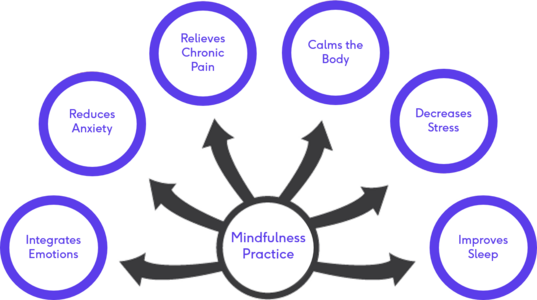
Explore Mindful Techniques For Stress and Find Calm Amidst The Chaos.
Anyone can suffer from relationship stress, and having it doesn't necessarily indicate that your relationship isn't working. Fear and worry frequently result from being unwilling to go though a breakup or from being afraid to be open because of past hurts, such as being duped on in previous relationships.
The following seven indications may indicate relationship stress these can be reduced by numerous mindful movement exercises.
1. The fear of vulnerability and commitment
Commitment problems may arise as a result of a bad experience in the past or from a lack of ease in expressing your emotions. Some people experience relationships as restricting, and attaching a label to them makes them feel even more anxious.
2. Breaking up with someone before things get serious
Connection stress may be present if you start to distance yourself from potential friends, cut individuals off before a connection develops, or engage in self-destructive habits. It's all included in your behavioural activation techniques.
3. Refusing to express your needs and desires out of concern that they'll leave
Feeling hesitant to express your ideas can be a sign that you are worried about the connection. Healthy partnerships need to be based on honesty and trust with Thought Patterns Therapy.
4. Inquiring into your partner's intentions
People who suffer from relationship stress frequently worry that their spouse will "find somebody better," question whether their partner genuinely cares for them, or constantly worry that their spouse will end the relationship for trivial or fictitious reasons.
5. Questioning your compatibility with your partner
It's possible to start emphasizing your partner's differences more than is required, such as having diverse musical or cinematic choices, to the point where you end up worrying about them more than you enjoy your compatibility.